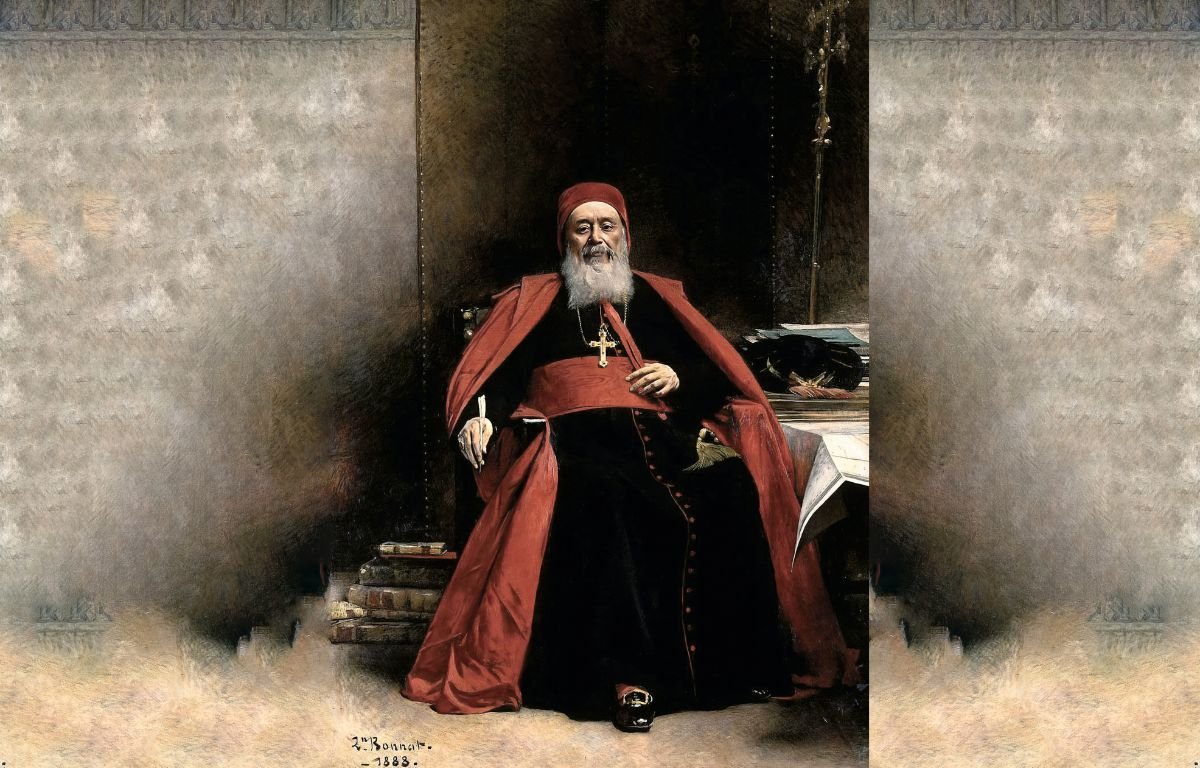
Charles Martial Allemand Cardinal Lavigerie
Charles Martial Allemand Lavigerie was born in Huire, Saint-Esprit, in the Bayonne countryside on 31 October 1825. His parents were Léon Philippe Allemand Lavigerie and Laure Louise Latrilhe. Léon Philippe, born in Angoulême on 17 June 1795, was the son of Martial Allemand Lavigerie (1767–1856) and Louise Vaslin (†1823). He migrated to Bayonne with his father in 1802 and later worked in the Customs Office. Laure Louise Latrilhe was born on 28 March 1800 in Bayonne, the daughter of Pierre Ainé Latrilhe (1764–1847) and Rose Agnès Fourticot (1779–1847). She did not practice a profession. Léon Philippe and Laure Louise married on 4 November 1824 and had four children: Charles Martial Allemand, Pierre Félix Allemand, Louise, and Léon Bernard Allemand.
From 1825 to 1837, Charles lived with his parents in Saint-Esprit. His two brothers and his sister were also born in Saint-Esprit. He was baptised in the Church of the Holy Spirit on 5 November 1825. Between 1837 and 1840, he studied at the Collège Saint-Léon in Bayonne. He received his First Communion in 1837 and the sacrament of Confirmation in 1838. At this time, the family lived in their new house in the Saint-Étienne suburb of Bayonne.
In 1840, Charles, accompanied by his father, met the bishop of Bayonne and expressed his desire to become a priest. He requested admission to the junior seminary, and the bishop agreed. He first attended the junior seminary at Larressore (1840–1841), then the junior seminary of Saint-Nicolas du Chardonnet in Paris (1841–1843).
From 1843 to 1845, Charles studied philosophy at the Seminary of Saint-Sulpice in Issy-les-Moulineaux. In 1845, he began theology studies at the Seminary of Saint-Sulpice in Paris. After his first year of theology (1845–1846), he was sent to the École des Hautes Études Ecclésiastiques (also known as the École des Carmes, now part of the Institut Catholique de Paris). He obtained the Baccalauréat and the Licence ès Lettres in 1847. He returned to Saint-Sulpice in Paris for the second and third years of theology (1847–1849). He was ordained subdeacon in 1847 and deacon in 1848. On 2 June 1849, he was ordained a priest at Notre-Dame Cathedral in Paris and incardinated into the diocese of Paris.
After his ordination, he taught for a few months at the Notre-Dame des Champs junior seminary in Paris. From December 1849 to July 1850, he prepared a doctoral thesis in history. On 12 July 1850, he defended his thesis on the Christian School of Edessa and was awarded the Doctorat ès Lettres by the Faculté des Lettres in Paris.
From 1850 to 1853, he served as assistant lecturer at the École des Carmes, chaplain to the Benedictine Sisters of the Temple, and chaplain to the Augustinian Sisters of Mary of the Inland. On 23 December 1853, he won the competition to become chaplain of the prestigious Church of Saint-Geneviève in Paris. However, in January 1854, he was appointed assistant lecturer at the Faculty of Theology of the Sorbonne, where he taught Church History from 1854 to 1861.
In December 1856, Charles was chosen as Director of the Œuvre des Écoles d’Orient, while also being promoted to Professor of Church History at the Sorbonne. As Director, he travelled throughout France fundraising for Christians in the Middle East.
When civil war broke out in the Middle East in 1860, he launched a major humanitarian appeal on behalf of the victims. From September to December 1860, he travelled to the region to distribute aid. During this mission, he met the renowned Algerian Muslim leader Emir Abd el-Kader, then exiled in Damascus. This first missionary journey deeply affected him; he described it as his “way of Damascus” and recognised in it the awakening of his missionary vocation.
In February 1861, he was awarded the title of Knight of the French Legion of Honour for his humanitarian work. He was appointed Auditor at the Tribunal of the Roman Rota in the Vatican. Two years later, on 16 March 1863, he was appointed bishop of Nancy-Toul (France). He was consecrated bishop on 22 March 1863 in the Church of San Luigi dei Francesi in Rome and installed in his diocese on 10 May 1863. His innovations included establishing the Pension and Provident Fund for priests, founding the Semaine religieuse de Nancy, reforming seminary training and teaching, establishing a diocesan canonical tribunal, and founding the Maison d’Étudiants. On 14 July 1866, he was promoted to Officer of the French Legion of Honour.
Following the death of the Archbishop of Algiers on 16 July 1866, Lavigerie was offered the vacant see. Convinced that this was God’s will, he accepted, believing that Jesus had chosen him to revive the evangelisation of African peoples from the northern to the central regions of the continent. On 27 March 1867, he became Archbishop of Algiers, the first to hold the title since the diocese had been elevated to an archdiocese on 25 July 1866.
He arrived in Algiers on 15 May 1867 and immediately began an impressive number of missionary initiatives. In 1868, he was appointed Apostolic Delegate (later Apostolic Vicar) for the Sahara and Sudan. He founded four missionary institutes: the Missionaries of Africa (1868), the Agricultural Brothers (1869), the Missionary Sisters of Our Lady of Africa (1869), and the Armed Brothers of the Sahara (1890). He participated in the First Vatican Council (1869–1870) as a member of the Commission for the Missions and the Oriental Churches.
Although he suffered from severe rheumatic neuralgia since seminary, he nonetheless carried out numerous bold projects for the evangelisation of African peoples. His creativity and missionary zeal were extraordinary. His first major work in Algeria was caring for the thousands of orphans left by famine. He sent missionaries to live among Saharan peoples. In 1875, he expanded the mission to Carthage and, in the same year, sent missionaries courageously across the Sahara toward sub-Saharan Africa. They were martyred. In 1878, with Holy See approval, he expanded missions to Jerusalem, Equatorial Africa, and Central Africa. His missionaries reached Lake Victoria in 1878 and spread from there across the region.
As the missions advanced, his missionaries confronted the horrors of African slavery and the slave trade. Lavigerie committed himself entirely to the abolition of slavery. He instructed his missionaries to redeem enslaved persons, protect them, and train them for the advancement of their societies. His missionary vision was holistic: proclaiming the Gospel, promoting works of charity, upholding the dignity of African cultures, living among African peoples, and fostering encounter and dialogue among cultures and religions. He rejected the distance that earlier missionaries had maintained toward Africans.
Lavigerie was created Cardinal-Priest in 1882. In 1884, he was appointed Archbishop of Carthage and Primate of Africa. From 1888 to 1890, he served as the Pope’s delegate for the Catholic Church’s international campaign against African slavery. He developed the Church’s mission in North Africa, Jerusalem, and across East, Central, and Southern Africa. He became one of the most renowned churchmen of the 19th century. Pope Leo XIII praised him as an active, zealous, astute, and industrious man who devoted himself to the spread of the faith and to building up the Church in Africa. Pope Pius XI later (in 1925) said that Lavigerie’s lasting glory would be that he “raised the siege of Carthage”—that is, restored the Church in Africa.
For the unity of France and for harmony between Church and State, on 12 November 1890, with papal approval, he called upon French Catholics to rally to the Republic. Although heavily criticised, he remained steadfast in his conviction that the future required dialogue and unity among peoples and institutions for the good of humanity.
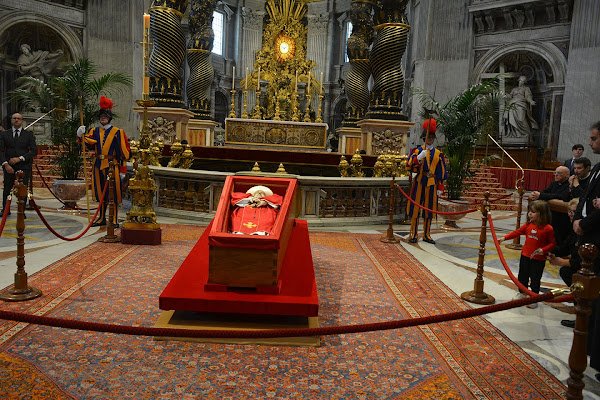
Charles Lavigerie died in Algiers on 26 November 1892. He was buried in the Basilica of Carthage on 8 December 1892, and his remains were transferred to Rome in 1964. At his funeral, a French diplomat recounted asking Lavigerie the source of his extraordinary energy. His reply was: “I am the servant of a Master who could never be locked in a tomb.” He used to tell his missionaries: “you are apostles, that is all you are.” He was an apostle of Jesus—that was all he was.